
Overview
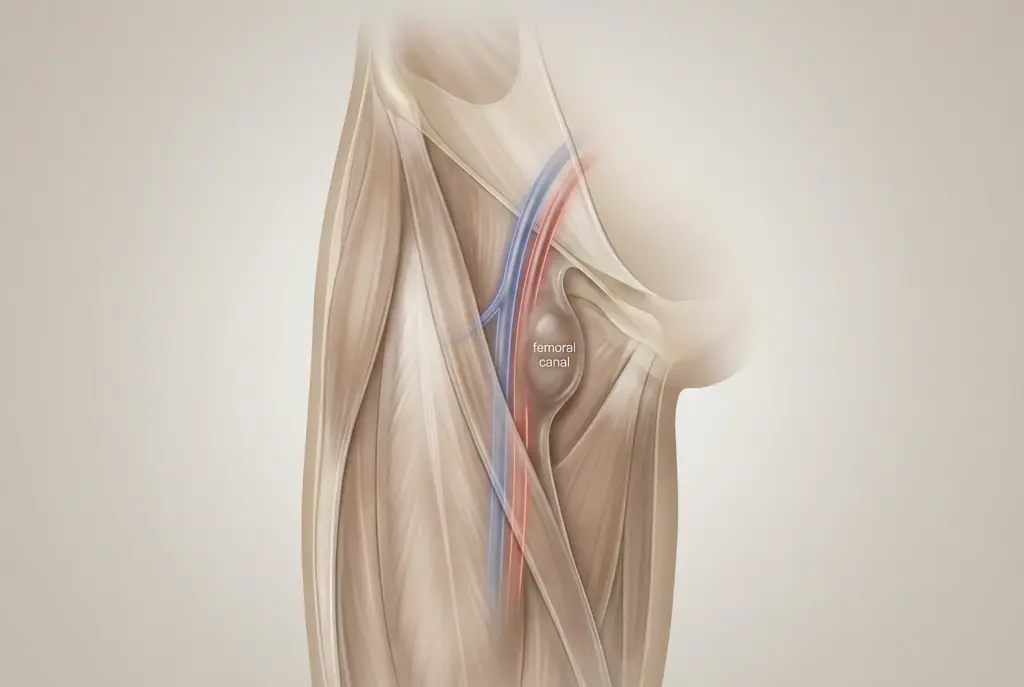
A femoral hernia occurs when tissue pushes through the femoral canal — a small passage in the upper inner thigh, just below the groin crease. Femoral hernias are less common than inguinal hernias but carry a significantly higher risk of strangulation, where the blood supply to the trapped tissue is cut off. This makes prompt surgical repair strongly advisable. Mr Woodward sees patients with femoral hernias quickly and prioritises timely assessment and treatment.
Conditions Treated
- Primary femoral hernia
- Symptomatic femoral hernia
- Femoral hernia at risk of strangulation
- Femoral hernia in women (more prevalent)
- Recurrent femoral hernia
The Procedure
Femoral hernia repair is performed under general or local anaesthesia. Mr Woodward uses either an open or laparoscopic approach depending on the patient’s presentation, anatomy, and fitness. The herniated tissue is carefully returned to the abdominal cavity and the femoral canal is closed securely to prevent recurrence. The most appropriate technique is discussed and agreed with the patient at the pre-operative consultation.
Recovery & Aftercare
Most femoral hernia repairs are performed as day cases and patients return home on the same day. Recovery is typically straightforward, with light activity resuming within one to two weeks and a full return to normal life within four weeks. Mr Woodward provides a post-operative care plan and follow-up appointment to confirm the repair has healed correctly.
Frequently Asked Questions
How urgent is femoral hernia repair?
Femoral hernias carry a higher risk of becoming strangulated than other hernia types. Early surgical repair is strongly recommended to avoid a more serious emergency.
How is femoral hernia repair performed?
Mr Woodward uses either open or laparoscopic technique depending on the individual case. The best approach is discussed at your pre-operative assessment.
Is a femoral hernia the same as an inguinal hernia?
No. Although both occur in the groin area, they arise in different anatomical locations. Femoral hernias sit lower and carry a higher risk of complications if left untreated.